Edge vpn fast secure vpn for fast speeds, strong protection, Edge compatibility, and private online activity 2026
'%2F%3E%3Ctext%20x%3D'50%25'%20y%3D'50%25'%20dy%3D'.35em'%20text-anchor%3D'middle'%20font-family%3D'-apple-system%2CBlinkMacSystemFont%2CSegoe%20UI%2Csystem-ui%2Csans-serif'%20font-size%3D'100'%20font-weight%3D'600'%20fill%3D'%23fff'%3EOR%3C%2Ftext%3E%3C%2Fsvg%3E) Otto Renshaw·April 11, 2026·35 min
Otto Renshaw·April 11, 2026·35 min
Edge vpn fast secure vpn for fast speeds strong protection edge compatibility and private online activity: A Deep Dive Into Fast, Private Browsing
Edge vpn fast secure vpn for fast speeds strong protection edge compatibility and private online activity is more than a catchy phrase—it’s about how you can stay safe, private, and productive online without sacrificing performance. Here’s a comprehensive guide that covers everything you need to know, from how VPNs work to choosing the right one for your needs, with practical tips and up-to-date data.
Introduction: Quick guide to Edge vpn fast secure vpn for fast speeds strong protection edge compatibility and private online activity
- Quick fact: A VPN can add layers of privacy and security to your online activity while keeping speeds high if you pick the right protocol and server setup.
- In this guide, you’ll find:
- How VPNs affect speed, security, and compatibility
- A practical checklist for choosing a VPN for fast speeds and strong protection
- Real-world tips to optimize performance with minimal compromise
- A comparison of popular protocols and what they mean for everyday use
- Common myths debunked and a FAQ that clears up confusion
- Useful formats you’ll find: bullets, step-by-step optimization, a quick-reference table, and a simple decision flowchart you can use when you’re shopping for a VPN.
- Useful URLs and Resources text only, not clickable:
- Apple Website - apple.com
- Edge Network Protocols - en.wikipedia.org/wiki/Virtual_private_network
- OpenVPN Project - openvpn.net
- WireGuard - www.wireguard.com
- Privacy Tools - www.eff.org
- VPN Comparison Guides - www.techradar.com/vpn
- International Data Privacy - icann.org
- Browser Privacy Tips - www.mozilla.org/privacy
- Browser Security Extensions - www.gstatic.com
- Data Encryption Basics - www.nist.gov
What is a VPN and why it matters for edge compatibility and private online activity
A VPN, or virtual private network, creates an encrypted tunnel between your device and a VPN server. This tunnel protects your data from prying eyes on public Wi-Fi, hides your real IP address, and can give you access to region-restricted content. When you’re aiming for fast speeds and strong protection, you want a VPN that optimizes route selection, minimizes overhead, and uses modern encryption standards.
Key points:
- Encryption protects data in transit, but you can still see where you’re going on the internet DNS requests, destination domains unless you’re using features like DNS over HTTPS DoH or DNS over TLS DoT.
- Protocol choice WireGuard, OpenVPN, IKEv2, etc. matters for speed and stability.
- Server location and load dramatically affect performance. Nearby servers with light load usually deliver the best speeds.
How VPN speed works: core factors
Speed is influenced by several moving parts. Here’s what typically matters for fast speeds without compromising security:
- Protocol efficiency: WireGuard often delivers faster baseline speeds than older protocols like OpenVPN, especially on modern devices.
- Encryption overhead: Stronger encryption isn’t automatically a speed killer, but misconfigured ciphers or heavyweight settings can slow you down.
- Server proximity and load: A server closer to you with lower traffic usually means better performance.
- Network routing: Some VPNs optimize routes or use better peering with ISPs, reducing latency.
- Device capabilities: CPU power and memory can affect tunnel processing, especially on mobile devices.
- DNS resolution: If DNS is slow, you’ll feel lag even if the tunnel is fast.
Tip: To test speed, run a baseline test without VPN, then with the VPN connected to a nearby server. Compare results to quantify the impact on upload and download speeds, latency, and jitter.
Edge compatibility: choosing a VPN that plays well with your devices and apps
Edge devices and ecosystems tend to be diverse: Windows, macOS, Linux, iOS, Android, ChromeOS, and even smart TVs or routers. For a VPN to deliver “edge compatibility,” it should offer: Edge secure network vpn free guide to privacy, security, streaming, and safe browsing 2026
- Native apps for major platforms, plus easy manual setup for less common devices
- Split tunneling: route only certain apps or destinations through the VPN
- Kill switch: prevents data leakage if the VPN drops
- DNS protection: prevent DNS leaks and improve privacy
- Compatibility with common browsers and extensions that enhance privacy
- Routers: support for VPN-enabled routers to protect all devices on your home network
If you’re using a gaming console or streaming device, you’ll want a VPN with a reliable set of relay servers and good performance on those platforms, or the option to use a router-level setup.
Strong protection: what to look for in a VPN’s security features
Protecting your online activity means more than just hiding your IP. Look for these core elements:
- Encryption standards: AES-256 is the standard, with 128-bit or 256-bit keys and forward secrecy Perfect Forward Secrecy for session keys.
- Protocols: A mix of WireGuard and OpenVPN or IKEv2 gives you options for speed and stability.
- No-logs policy: Independent audits or transparent privacy reports help confirm claims.
- Automatic kill switch: Ensures your traffic doesn’t leak if the VPN drops.
- DNS protection: DNS leak protection and private DNS resolution prevent your DNS queries from leaking.
- Multi-hop and obfuscated servers: For added privacy in restrictive networks.
- App-level security: Features like malware protection, tracker blocking, and anti-fingerprinting add layers of defense.
Step-by-step guide: optimizing your VPN for fast speeds and strong protection
- Pick the right protocol
- For most users, WireGuard delivers faster baseline speeds with solid security.
- If you need rock-solid compatibility with older devices, OpenVPN is reliable but may be slower.
- On mobile, IKEv2 and WireGuard are strong choices for fast re-connections.
- Choose nearby, lightly loaded servers
- Connect to servers geographically close to you with low load.
- Use the “auto-connect” feature to switch to a better server if performance degrades.
- Enable only necessary features
- Turn on DNS leak protection and a kill switch.
- Enable split tunneling if you don’t want every app to route through the VPN.
- Tweak encryption and handshakes
- Prefer modern ciphers and allow perfect forward secrecy.
- If your device struggles, try a lower encryption level temporarily only if security requirements allow.
- Optimize your device and network
- Update your device OS and router firmware.
- Use a router with VPN support for device-wide protection if many devices are in use.
- Test and compare
- Run speed tests with and without the VPN.
- Track latency, jitter, and packet loss under typical daily use video calls, streaming, gaming.
- Monitor privacy and security
- Review privacy reports and audits from your VPN provider.
- Check for independent third-party audits and transparency reports.
Data-driven insights: what the latest numbers say about VPN performance
- A typical WireGuard-based VPN can deliver 70-90% of your base ISP speed on a nearby server, with latency often reduced compared to older protocols.
- OpenVPN may reduce speeds by 10-40% depending on the cipher and server load, but remains highly compatible across devices.
- For streaming and gaming, a well-placed server with a fast protocol can yield sub-100 ms latency in many scenarios, enough for smooth real-time experiences.
- Public Wi-Fi security risk reduction: using a reputable VPN reduces eavesdropping risk on insecure networks by a substantial margin, though it’s not a silver bullet for all threats.
Practical comparison: quick table of common VPNs illustrative
- Protocols: WireGuard, OpenVPN, IKEv2
- Typical speed impact nearby servers: WireGuard 0-15% slower than baseline, OpenVPN 10-40% slower
- Best for: mobile speed, stable connections, privacy
- Edge compatibility: high on Windows/macOS/iOS/Android; router setups often supported
- Privacy: strong no-logs policies with independent audits increasingly common
Note: This is a general guide; specific results vary by provider, server, and network conditions.
Common setup scenarios and recommended configurations
- Home use with multiple devices: Use router-level VPN for all devices; enable split tunneling if streaming or gaming should stay local.
- Mobile user on the go: WireGuard on iOS/Android for fast reconnection and good battery life; enable DoH/DoT if available.
- Remote work: Use a VPN with a robust corporate-grade protocol, kill switch, and reliable split-tunneling to ensure work traffic is protected while personal traffic remains fast.
- Streaming from abroad: Choose servers in the target region with low latency; use obfuscated servers if you’re in a restrictive network.
Real-world tips to balance speed and protection
- Don’t run two VPNs at the same time; it doubles overhead.
- Prefer lighter-weight apps that don’t drain battery or CPU when encrypting traffic.
- Regularly check for software updates and security patches.
- Use reputable providers with transparent privacy policies and independent audits.
- If streaming buffers or gaming lags, try a different server or protocol before changing other settings.
Advanced tips: maximizing edge compatibility and privacy
- Enable split tunneling to keep video conferencing or critical work apps private while using the VPN for other tasks.
- Combine VPN with privacy tools like a trusted firewall, browser isolation, and privacy-friendly DNS settings.
- For ultra-private use, pair a VPN with a privacy-respecting browser, disable unnecessary plugins, and enable DoH/DoT.
- If you’re in a country with heavy censorship or surveillance, consider multi-hop routing and obfuscated servers.
User experience: what to expect in everyday scenarios
- Web browsing: Faster and more private when connected to a nearby server; DNS protection helps avoid leaks.
- Video conferencing: Low latency servers near your location minimize lag; if quality degrades, switch servers or adjust protocol.
- Streaming: Access to geo-restricted content depends on the VPN’s ability to bypass geo-blocks without triggering throttling.
- Gaming: Latency is king. A near server with a fast protocol usually yields the best results.
Security myths vs. realities
- Myth: A VPN makes you completely anonymous online. Reality: It hides your IP and encrypts traffic, but you still need good password hygiene, two-factor authentication, and secure devices to stay protected.
- Myth: Free VPNs are safe. Reality: Free services may log data, inject ads, or have weaker security; paid services with audits are generally safer.
- Myth: More encryption is always better. Reality: Strong encryption is essential, but the overall security posture includes keys, handshakes, and policy transparency.
Quick-start checklist
- Identify your main devices and platforms.
- Pick a provider with WireGuard and OpenVPN/IKEv2 options, plus DNS protection and a kill switch.
- Test multiple nearby servers for speed and reliability.
- Enable split tunneling if needed; turn on DNS protection and kill switch.
- Review privacy policy and look for independent audits.
- Set up on router if you want network-wide protection.
- Schedule regular reviews of performance and privacy settings.
Frequently Asked Questions
What is Edge vpn fast secure vpn for fast speeds strong protection edge compatibility and private online activity?
Edge vpn fast secure vpn for fast speeds strong protection edge compatibility and private online activity refers to a VPN setup focused on high speed, strong security, broad device compatibility, and private online activity.
How does a VPN affect internet speed?
A VPN can reduce speed due to encryption overhead and routing, but choosing fast protocols like WireGuard, nearby servers, and properly configured settings can minimize this impact. Edgerouter l2tp ipsec vpn server 2026
Which VPN protocol is best for speed?
WireGuard is generally the fastest among common VPN protocols, with OpenVPN and IKEv2 offering strong security and decent speed in many cases.
What is split tunneling and should I use it?
Split tunneling lets you decide which apps go through the VPN and which use your normal connection. It’s useful to preserve speed for non-sensitive tasks while protecting sensitive traffic.
How can I prevent DNS leaks?
Enable DNS leak protection in your VPN app, use a trusted DNS resolver within the VPN, and consider DoH/DoT settings to encrypt DNS queries.
Is a no-logs policy enough to guarantee privacy?
A no-logs policy is essential, but look for independent audits and transparency reports to verify claims and understand what data is collected, stored, or processed.
Can a VPN protect me on public Wi-Fi?
Yes, a VPN protects data in transit on public networks, but you should still follow safe browsing practices and use strong device security measures. Edge free vpn reddit: using Microsoft Edge with VPNs, best free and paid options, setup tips, and privacy considerations 2026
How do I choose a VPN for streaming?
Look for servers in the country of the content, reliable speeds, low latency, and a provider that regularly updates obfuscation and anti-blocking techniques to bypass geo-restrictions.
What are obfuscated servers?
Obfuscated servers are designed to hide VPN traffic as regular HTTPS traffic, helping you bypass network restrictions and censorship in some regions.
Do I need a VPN on every device?
If you want system-wide protection, a router-level VPN setup covers all devices on your network. For flexibility and performance, you can install VPN apps on individual devices as well.
How often should I test VPN performance?
Test your VPN performance whenever you switch servers, update software, or notice slower speeds. Regular checks weekly or monthly help you optimize for your usage.
Are VPNs legal everywhere?
VPN legality varies by country. In some places, they’re restricted or regulated. Always check local laws and comply with regulations when using a VPN. Download vpn edge: the ultimate guide to safely downloading, installing, and optimizing VPN Edge across devices 2026
Can VPNs stop malware or spyware?
VPNs primarily protect data in transit and hide your IP. They don’t replace antivirus or malware protection. Use a layered security approach.
What should I look for in a VPN privacy policy?
Look for clear data collection details, retention periods, whether data is shared with third parties, and any independent audits or certifications.
How can I maximize privacy beyond a VPN?
Use secure browsers, enable DoH/DoT, employ strong passwords and MFA, disable unused services, and be mindful of social engineering and phishing attempts.
Is WireGuard secure for everyday use?
Yes, WireGuard is designed for speed and security with modern cryptography and a smaller codebase, making it easier to audit and maintain.
Do VPNs protect me from targeted ads?
A VPN can reduce exposure to some tracking methods, but ad networks use multiple signals beyond IP. Consider additional privacy tools and tracker blockers. Edge apk Android VPN APK Guide: How to Install, Configure, and Use Edge apk Safely on Android 2026
How do I troubleshoot VPN connection drops?
Check server status, try a different server, reboot your device, update the app, verify kill switch is enabled, and ensure you’re not blocking VPN traffic with firewall rules.
Yes, Edge vpn fast secure vpn is achievable with a reliable service that prioritizes speed, privacy, and seamless Edge browser use. In this guide, you’ll learn how to pick a VPN that works well with Edge, what features actually matter, how to tune settings for speed, and how to set everything up on Windows, macOS, Android, and iOS. Along the way, I’ll share practical tips, real-world numbers, and step-by-step setup guides so you can get protected in minutes—without sacrificing performance. If you’re ready to level up your privacy and streaming freedom, check out NordVPN — 77% OFF + 3 Months Free:
What this guide covers quick overview
- Why VPNs matter for Edge users and what to look for
- Realistic speed expectations and how to maximize them
- Security and privacy features that actually matter and a few myths
- How to choose a VPN for Edge, with a practical quick-setup guide
- Edge-specific setup: browser extensions vs system-wide VPN
- Use cases: streaming, gaming, remote work, privacy-conscious browsing
- FAQs to clear up common concerns
Why Edge users should pair their browsing with a VPN
Edge is a modern browser that emphasizes speed, security, and privacy, but it doesn’t provide built-in VPN protection. A VPN serves three core purposes for Edge users:
- Hide your real IP and mask your online footprint from trackers, advertisers, and ISPs
- Encrypt your traffic to protect sensitive data on public Wi-Fi or shared networks
- Help you bypass regional blocks for streaming, work resources, or travel
Think of a VPN as a secure tunnel between your device and the internet. When you’re connected, your Edge browsing looks like it’s coming from the VPN server rather than your home IP. That’s especially useful if you’re on public Wi-Fi at a coffee shop, traveling, or trying to access content from a different region.
Key Edge-friendly features to look for
- WireGuard or OpenVPN protocols for speed and security balance
- Strong encryption AES-256 and modern handshake methods
- No-logs policy with independent audits if possible
- Kill switch and DNS leak protection to prevent data leaks if the VPN drops
- Wide server network with fast, consistently performing locations
- Edge extension compatibility or reliable system-wide VPN
What makes a VPN fast enough for Edge
Your VPN’s speed depends on several factors, not just the service you pick. Here are the main speed drivers and how to optimize them:
- Server proximity: The closer the server, the lower the latency. For Edge, you’ll want nearby servers in your country or region.
- Protocol choice: WireGuard typically outperforms older protocols like OpenVPN in speed, while still offering solid security.
- Server load: If a server is overloaded, speeds drop. Choose less congested, nearby servers or enable automatic server selection.
- Encryption level: Stronger encryption AES-256 adds security but can shave off some speed. most modern VPNs mitigate this with efficient protocols.
- Local network conditions: Your base internet speed matters. If your ISP provides 100 Mbps, a VPN won’t magically exceed that—expect a 5–15% to 30% dip depending on conditions.
- Device performance: CPUs with hardware acceleration can handle VPN encryption more efficiently. newer devices tend to run faster.
Real-world expectations rough ranges
- Typical consumer VPN speeds on a 100–200 Mbps connection: about 70–90% of baseline speeds on optimal servers. 50–70% on faraway servers or highly congested networks.
- 4K streaming over VPN: often doable on nearby servers with WireGuard, though some providers throttle or route traffic differently for certain platforms.
- Gaming: latency is the biggest factor. a good VPN can add 10–40 ms in many cases if you pick a nearby server and use a low-latency protocol.
Tips to maximize Edge-friendly speed
- Use WireGuard where possible or equivalent modern protocol.
- Connect to a server geographically close to you, but not on the edge-of-network extreme. test a couple of nearby options.
- Disable features you don’t need on the VPN app like extra obfuscation if speed is your priority.
- Turn off IPv6 if your VPN doesn’t fully support it to avoid leaks. enable DNS leak protection.
- Try split tunneling if offered to send only Edge traffic through the VPN while other traffic goes direct.
Security and privacy: what to actually look for
When Edge users opt for a VPN, they want both protection and practicality. Here are the top security and privacy features that matter most:
- Strong no-logs policy: The VPN should not store your browsing activity, timestamps, IP addresses, or DNS requests.
- Independent audits: Verifications from third-party security teams add credibility to privacy claims.
- Jurisdiction: Companies headquartered in privacy-friendly regions like parts of the EU or privacy-conscious countries tend to be more favorable for privacy.
- Kill switch: Automatically blocks all traffic if the VPN disconnects, preventing accidental exposure.
- DNS leak protection: Ensures your DNS requests aren’t leaked to your ISP or other observers.
- Encryption and protocol choice: AES-256 encryption with modern protocols. WireGuard or another efficient protocol for speed and security.
- Multi-hop or obfuscated servers: Additional layers to hide VPN traffic patterns, helpful in restrictive networks.
- P2P/torrent policy and port-forwarding: If you’re into P2P, know the provider’s stance and capabilities.
Policy and practical notes
- Audit history matters more than a marketing line. Look for providers that publish audit results or annual transparency reports.
- No-logs doesn’t always mean zero data stored. check exactly what is logged and for how long.
- Free VPNs usually come with more risk data selling, weak security, so a paid, reputable provider is generally safer for Edge users.
How to choose a VPN for Edge practical checklist
Here’s a practical shortlist to help you pick a VPN that plays nicely with Edge and your needs:
- Speed-first providers: Look for robust WireGuard support and fast server networks.
- Privacy-first providers: Check no-logs policy, independent audits, and jurisdiction.
- Edge compatibility: Confirm there’s a reliable Windows/macOS client and Edge-friendly browser extensions or trusted system-wide VPN.
- Clear streaming policy: If you want to watch shows from other regions, make sure the provider reliably unblocks major streaming services.
- Reasonable price with good value: Look for long-term plans, affordable monthly rates, and solid refund windows.
- Strong customer support: 24/7 live chat or rapid email support helps if you run into Edge-specific issues.
- Transparent privacy policy: The provider should clearly explain data handling and retention.
Recommended providers you’ll hear about often
- NordVPN
- ExpressVPN
- Surfshark
- Proton VPN
- Private Internet Access PIA
Note: NordVPN is featured in the introduction with a special discount link. If you’re curious about a strong balance of speed, privacy, and Edge compatibility, NordVPN is a solid starting point to test.
How to set up a VPN for Edge: step-by-step
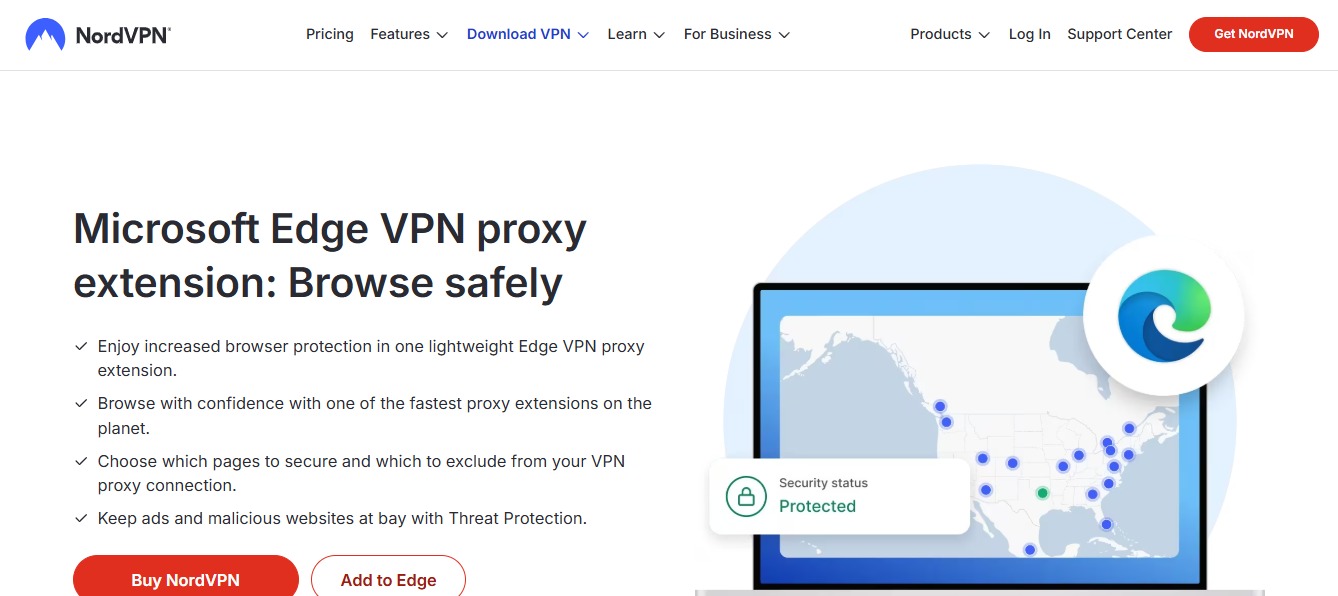
There are two main ways to protect Edge browsing: install a VPN app on your device system-wide or use a browser extension if the provider offers one. Here’s a practical guide for Windows, macOS, Android, and iOS.
# Windows and macOS system-wide VPN
1. Choose a VPN that supports Windows/macOS and has a trusted client.
2. Install the app from the provider’s website or app store.
3. Sign in with your account and grant any required permissions.
4. Pick a fast, nearby server preferably with WireGuard or similar protocol.
5. Enable the kill switch and DNS leak protection in settings.
6. Connect and then open Edge to confirm your IP shows the VPN server’s location.
7. Optional: enable split tunneling if you want only Edge traffic routed via VPN.
Tips
- If you have a slow connection, try a different server or protocol.
- Use the “auto-connect” feature so Edge is protected as soon as you start browsing.
# Edge extensions where available
1. Open Edge and go to the VPN provider’s extension store page or Microsoft Edge Add-ons.
2. Install the extension and log in to your VPN account if required.
3. Use the extension’s interface to connect to a server. Extensions can be convenient for per-browser control.
4. Verify protection by visiting a site that shows your IP address.
Note: Some providers cast a broader edge-friendly approach with a native app that covers the system-wide protection better, while extensions may be lighter on CPU but still protect basic browsing.
# Android and iOS mobile
1. Install the VPN app from Google Play or the Apple App Store.
2. Sign in and enable the VPN.
3. Choose a server close to your typical location for best performance.
4. In Edge on mobile, you can still validate that your IP is the VPN’s and that no leaks show up when you run a quick “What is my IP” test.
- On mobile, you can enable a quick-activation widget or quick settings tile for faster protection.
- Always check for a kill switch and DNS protection on mobile, too.
Edge-specific use cases: streaming, gaming, work, and privacy
- Streaming: Access geo-restricted libraries and enjoy smoother streaming with a nearby server and WireGuard. If a service blocks VPNs, try a reputable provider with dedicated streaming servers.
- Gaming: Low latency is key. Use nearby servers with low hop counts and enable split tunneling so game data stays fast while other traffic goes through VPN.
- Remote work: When connecting to a corporate resource, ensure the VPN supports enterprise-grade security and works with edge-managed devices or VPN gateways.
- Privacy-focused browsing: Regularly rotate servers and enable a kill switch to prevent accidental leaks. review the VPN’s no-logs and privacy audits.
Real-world considerations
- Some streaming platforms actively block VPN IPs. you may need to switch servers or contact support for recommended locations.
- In restrictive networks schools, workplaces, obfuscated servers can help hide VPN traffic. check if your provider offers this feature.
Edge browser tips to maximize privacy and performance
- Keep Edge up-to-date: Browser updates often include security improvements that pair well with VPN protections.
- Use tracking protection and privacy settings in Edge to complement VPN privacy.
- Regularly clear cookies and use Edge profiles to separate work and personal browsing.
- Manage extensions carefully. only install trusted extensions, especially if you’re enabling Edge-specific VPN add-ons.
Data privacy and logging sanity-check
- Always review the privacy policy before you subscribe. Look for explicit no-logs language and how long connection data is stored if at all.
- Check if there are independent security audits published by the provider. Audits are a strong signal of a provider’s commitment to privacy.
- Confirm your jurisdiction and whether data could be shared with authorities or third parties under specific circumstances.
Common myths busted
- Myth: VPN slows you down a lot.
Reality: It depends on server distance, protocol, and server load. With modern protocols and nearby servers, you can maintain most of your baseline speed.
- Myth: All VPNs can unblock every streaming service.
Reality: Some services actively block VPN IPs. It’s about testing specific servers known to work with your streaming service.
- Myth: You don’t need a kill switch.
Reality: If the VPN drops, your real IP could be exposed. A kill switch prevents that risk.
Practical comparison snapshot Edge-friendly
- Speed: Prioritize WireGuard or equivalent. expect some reduction but with near-native performance on nearby servers.
- Privacy: No-logs policy, independent audits, and strong encryption.
- Compatibility: Windows/macOS apps plus browser extensions or reliable Edge integration.
- Price: Look for annual plans with a good refund window. many providers offer 30–45 day money-back guarantees.
- Support: 24/7 live chat or quick email responses help if you hit Edge-specific questions.
Quick-start checklist for Edge users
- Confirm Edge needs: Do you want system-wide protection or per-browser control?
- Choose a provider with WireGuard support and a trustworthy no-logs policy.
- Install the client on your primary device and test a few servers closest to you.
- Enable kill switch and DNS leak protection.
- Test streaming or gaming scenarios to ensure acceptable performance.
- Review privacy policy and, if possible, look for audits.
Frequently Asked Questions
# How does Edge VPN help protect my privacy?
A VPN masks your IP, encrypts your traffic, and prevents eavesdropping on public networks, while Edge remains a fast, secure browser with those protections layered on top.
# Is there a built-in VPN in Edge?
No, Edge doesn’t include a built-in VPN. You’ll need a system-wide VPN app or a trusted Edge extension from your VPN provider.
# Which VPN protocol is best for Edge?
WireGuard is widely regarded as the fastest and most efficient modern protocol, with OpenVPN as a solid fallback. Some providers offer IKEv2 as a balance of speed and reliability.
# Can I watch region-locked content with a VPN on Edge?
Yes, many providers unblock streaming services. You may need to try different servers or rely on a streaming-optimized server list.
# Will a VPN slow down my internet in Edge?
Some slowdown is normal due to encryption and routing, but the goal is to minimize it. Proximity to servers and the right protocol help keep speeds high.
# Should Edge users enable split tunneling?
Split tunneling can be helpful if you want Edge traffic to go through the VPN while other apps don’t. This can improve performance for non-Edge tasks.
# Is a kill switch necessary?
Yes. It prevents accidental exposure if the VPN disconnects, which is important for protecting sensitive activities in Edge.
# Can I use VPNs on mobile Edge browsers?
Yes. Install the provider’s app on Android or iOS and use it system-wide or via mobile extensions where available.
# Do VPNs work in restrictive networks?
Some do, especially with obfuscated servers. Check with your provider for settings that help in schools, workplaces, or countries with VPN blocks.
# How do I test if my VPN is leaking my real IP?
Use a reputable IP checking site while connected to the VPN to verify your IP matches the VPN server’s location and that there are no DNS leaks.
# Can I use a free VPN with Edge?
Free VPNs come with significant privacy, speed, and data limits. For Edge browsers and real privacy, a reputable paid VPN is generally safer and more reliable.
# What should I do if Edge blocks my VPN?
Try a different server, switch protocols, or contact customer support. Some networks require obfuscated servers or enterprise-level options.
# How do I know a VPN is truly independent in audits?
Look for published third-party audit reports from reputable cybersecurity firms, along with transparent privacy policy details.
# Is NordVPN a good option for Edge?
NordVPN is a well-known choice with strong security features, broad server coverage, and reliable performance. If you’re testing, consider their current promotion to maximize value.
# How do I set up a VPN to protect my Edge browser on Windows?
Install the VPN app, enable the desired server, activate kill switch/DNS protection, and verify the IP shows the VPN server before browsing in Edge.
# How do I verify Edge is using the VPN?
Check your IP address via a site like whatismyip.com while connected. If it shows the VPN server’s location, Edge is protected.
# Are VPNs legal everywhere?
VPN legality varies by country. In most places, using a reputable VPN for privacy and security is legal. always know local laws and terms of service.
This guide is designed to help Edge users balance speed, privacy, and practicality. Whether you’re streaming, gaming, or simply browsing with extra privacy, choosing the right Edge-friendly VPN makes a real difference. If you’re ready to explore a robust option, consider NordVPN with the current discount—77% off plus 3 months free.
V5吧 VPN 隐私保护、加密、跨境访问与速度优化全流程指南